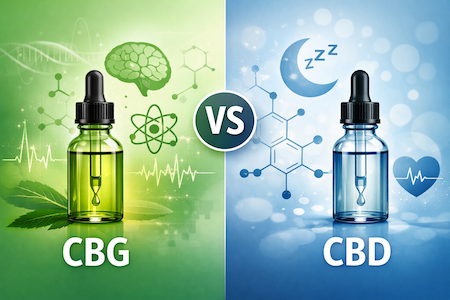
CBG vs CBD at a Glance
CBG and CBD are both non-intoxicating cannabinoids derived from the cannabis plant, but they produce notably different effects. While CBD is renowned for its calming properties and extensive research backing, CBG is gaining attention for its potential to support focus, mental clarity, and targeted inflammation support.
- CBD: Calming, widely researched, abundant in hemp, ideal for anxiety and sleep support
- CBG: Focusing, emerging research, naturally scarce, promising for daytime energy and gut health
- Both: Non-intoxicating, interact with the endocannabinoid system, available in similar product formats
Both cannabinoids are typically derived from hemp legalized in the U.S. under the 2018 Farm Bill, provided the delta-9 THC content remains below 0.3%. However, state laws continue to vary as of 2024, so checking local regulations before purchasing is always wise.
This guide will help you understand the key differences between CBG and CBD, explore their potential benefits, and decide when to reach for one, the other, or a combination based on goals like pain relief, focus, sleep support, and gut health.
Introduction to Cannabinoids and the ECS
Cannabinoids are biologically active compounds found in Cannabis sativa that interact with a complex signaling network in your body called the endocannabinoid system. Understanding how this system works is essential to grasping why CBG and CBD produce such different effects despite coming from the same plant.
The most famous cannabinoid is THC, which produces intoxicating effects by strongly activating certain receptors in the brain. CBD and CBG, by contrast, are two non psychotropic cannabinoids that don’t cause a “high” at typical doses. They influence the body in subtler, more modulatory ways.
The body’s endocannabinoid system regulates a wide range of functions:
- Pain perception: Helps modulate how the body responds to discomfort
- Mood and stress: Influences emotional balance and resilience to everyday stress
- Sleep cycles: Supports healthy circadian rhythms and rest quality
- Appetite and digestion: Affects hunger signals and gut function
- Immune response: Helps regulate inflammation and immune activity
This system operates primarily through two types of cannabinoid receptors:
- CB1 receptors: Concentrated in the central nervous system and brain, influencing mood, memory, pain, and motor function
- CB2 receptors: Found mainly in immune cells and peripheral tissues, playing key roles in inflammation support and immune modulation
CBD and CBG interact with these receptors differently, which is why they produce distinct biological effects. This fundamental difference in how each cannabinoid engages the endocannabinoid system forms the foundation of everything we’ll explore in this article.
What Is CBG? The “Mother” Cannabinoid
CBG, or cannabigerol, is a minor cannabinoid typically found at concentrations of 1% or less in mature hemp plants. Despite its scarcity, CBG has earned significant attention in cannabinoid research for its unique origin and pharmacological aspects. Shop one of the most popular CBG products here.
CBG originates from CBGA (cannabigerolic acid), often called the parent molecule of all cannabinoids. As the cannabis plant matures, enzymes convert CBGA into other acidic cannabinoids like CBDA, THCA, and CBCA. When heat is applied (through smoking, vaping, or processing), these acids transform into the cannabinoids present in most products: CBD, THC, and CBC.
This is why CBG is called the mother cannabinoid—without CBGA, major cannabinoids like CBD and THC simply wouldn’t exist. It’s the biochemical starting point for the plant’s entire cannabinoid profile.
- Natural abundance: Typically less than 1% in mature plants, making CBG extraction more challenging and expensive
- Early harvest requirement: Breeders cultivate high CBG hemp extract varieties and harvest earlier to maximize CBG content before conversion
- Receptor activity: Research suggests CBG interacts more directly with CB1 and CB2 receptors than CBD does
- Other targets: CBG also appears to engage TRP channels and alpha-2 adrenergic receptors, which may explain its focusing and anti inflammatory properties
- User reports: Many people describe CBG as providing mental clarity and daytime energy without the jitteriness of stimulants
What Is CBD? The Most Studied Non-Intoxicating Cannabinoid
CBD, or cannabidiol, is a major cannabinoid that can comprise 20-40% of hemp extract, making it far more abundant and accessible than CBG. It’s the most researched non-intoxicating cannabinoid, with hundreds of studies examining its potential therapeutic effects.
CBD doesn’t cause intoxicating effects because it doesn’t bind strongly to CB1 receptors in the brain. In fact, research suggests CBD can actually dampen some of THC’s side effects by acting as a negative allosteric modulator at these receptors.
Rather than directly activating cannabinoid receptors, CBD works largely through indirect mechanisms:
- FAAH inhibition: CBD inhibits fatty acid amide hydrolase, the enzyme that breaks down anandamide (your body’s natural “bliss molecule”), effectively raising anandamide levels
- Serotonin modulation: CBD interacts with 5-HT1A receptors, which may explain its anxiolytic and mood-balancing effects
- Multiple receptor targets: CBD also influences TRPV1 (pain and heat sensing), GPR55, and PPAR-γ nuclear receptors
Hemp derived CBD is available in numerous product formats:
- Oils and tinctures: Sublingual drops for relatively fast absorption
- Gummies and edibles: Convenient, tasty, with slower onset but longer duration
- Capsules: Precise dosing for consistent daily use
- Topicals: Creams, balms, and roll-ons for localized discomfort relief
- Prescription CBD: Epidiolex, FDA-approved in 2018 for certain seizure disorders like Lennox-Gastaut and Dravet syndromes
By 2024, CBD products are widely available in the U.S. and many other countries, though regulations on marketing claims and product labeling remain strict. The scientific evidence supporting CBD’s use continues to grow, particularly for epilepsy treatment, anxiety, and pain management.
Key Differences Between CBG and CBD
Understanding the core distinctions between CBG and CBD helps you choose the right cannabinoid for your wellness routine. While both come from the same plant family and share certain characteristics, their chemistry, receptor activity, and real-world effects differ substantially.
- Abundance: CBD is plentiful in hemp (often 10-20% of flower weight), while CBG remains scarce at around 1% or less in mature plants
- Research depth: CBD has extensive human studies and one FDA-approved drug; CBG has promising but mostly preclinical data from animal models and in vivo studies
- Price point: CBG products typically cost more per milligram due to lower yields and more complex extraction
- Subjective effects: Users often describe CBD as calming and grounding, while CBG tends to be associated with focus and alertness
- Receptor engagement: CBG appears to interact more directly with ECS receptors, while CBD works more as a modulator
Both molecules share the same chemical structure formula (C21H30O2), but their atoms are arranged differently. These isomeric differences create distinct binding profiles at various receptors throughout the body.
Chemical Structure and Receptor Targets
CBG and CBD are phytocannabinoids with identical molecular formulas but different three-dimensional shapes. This structural variation is what creates their unique binding profiles and distinct effects.
CBG’s receptor profile:
- Greater direct affinity for CB1 and CB2 receptors (partial agonist activity)
- Notable actions at TRPV1 and TRPA1 channels (involved in pain and temperature sensing)
- Strong alpha-2 adrenergic receptor agonism (linked to focus, blood pressure, and neurotransmitter release)
- 5-HT1A antagonism (may contribute to its energizing rather than sedating profile)
CBD’s receptor profile:
- Weak binding at CB1 and CB2, functioning more as a modulator
- Significant influence on 5-HT1A serotonin receptors (anxiolytic effects)
- TRPV1 activation and desensitization (pain modulation)
- GPR55 and PPAR-γ interactions (inflammation and metabolic effects)
Think of it this way: CBG is like a key that fits directly into several locks, turning them to produce specific effects. CBD is more like a lubricant that keeps the entire lock mechanism working smoothly without forcefully turning any single lock.
These structural and receptor differences help explain why CBG often feels more focusing and immediate, while CBD builds a calming, balancing effect over time.
How CBG vs CBD Interact With the Endocannabinoid System
Both cannabinoids support ECS balance, but through different pathways that affect mood, pain, inflammation, and cognition in distinct ways.
How CBG interacts with the ECS:
- Partial agonist at CB2 receptors, directly influencing immune and inflammatory pathways
- Measurable CB1 activity that may affect mood, pain perception, and appetite
- Inhibits FAAH to raise anandamide levels, similar to CBD
- Combined actions may produce a more “activating” or focusing effect
How CBD interacts with the ECS:
- Indirect ECS modulation through FAAH inhibition, prolonging anandamide’s calming effects
- Negative allosteric modulation at CB1, slightly altering receptor shape and dampening overactive signaling
- Broader influence across multiple non-cannabinoid receptor systems
- Generally produces a more gradual, “smoothing” effect on body systems
When combining CBG and CBD, many users report an entourage effect where CBD “rounds off” intensity while CBG adds clarity and precision. This is why many products blend both cannabinoids for balanced wellness benefits.
Therapeutic Benefits of CBG vs CBD
Research into both cannabinoids is ongoing, but early studies and user reports suggest each has distinct strengths. The evidence base ranges from cell and animal research (more common for CBG) to human clinical trials (more developed for CBD, especially in epilepsy and anxiety).
Main areas where both cannabinoids are being explored:
- Pain and inflammation management
- Anxiety and mood support
- Focus and cognitive performance
- Gut health and digestive support
- Neuroprotective properties
- Sleep quality improvement
It’s important to use careful language here: neither CBG nor CBD is FDA-approved for most wellness applications. The scientific evidence is still developing, particularly for CBG, and phrases like “may support” or “shows promise” more accurately reflect the current state of research.

CBG Benefits: Inflammation, Neuroprotection, and Gut Support
CBG’s potential health benefits are generating significant interest in cannabinoid research, though most evidence comes from preclinical studies rather than large human trials.
Inflammation and neuroprotection:
- Animal models of Huntington’s disease have shown CBG may have neuroprotective properties
- Research suggests CBG could help reduce neuroinflammation and oxidative stress
- Early research indicates potential therapeutic applications for neurological disorders
Antibacterial potential:
- Laboratory studies have demonstrated CBG’s effectiveness against resistant bacteria like MRSA
- This potential anti inflammatory and antimicrobial profile distinguishes CBG from other cannabinoids
Gut health support:
- Animal studies on inflammatory bowel disease models suggest CBG may reduce intestinal inflammation
- Research points to improved intestinal barrier function in colitis-like conditions
- CBG’s direct CB2 receptor activity may be particularly relevant for inflammatory diseases of the gut
Focus and mental clarity:
- Many users report enhanced focus and steady daytime energy without jitteriness
- CBG’s alpha-2 adrenergic activity and 5-HT1A antagonism may underlie these cognitive effects
- Anecdotal reports position CBG as a “functional” cannabinoid for productivity
Important caveat: Human studies on CBG remain limited as of 2024. While preclinical findings are encouraging, more rigorous clinical data are needed before making strong therapeutic claims.
CBD Benefits: Anxiety, Seizures, Pain, and Sleep
CBD’s potential benefits are supported by substantially more scientific evidence, including human trials and regulatory approval for specific medical uses.
Seizure disorders:
- The FDA approved Epidiolex (purified CBD) in 2018 for Lennox-Gastaut and Dravet syndromes
- Clinical trials demonstrated significant seizure reduction in treatment-resistant epilepsy
- This represents the strongest clinical validation for any cannabinoid besides THC
Anxiety disorders:
- Multiple human studies suggest CBD can reduce symptoms of generalized and social anxiety
- Research typically uses moderate to high oral doses (300-600mg in experimental settings)
- CBD’s 5-HT1A receptor activity likely contributes to its anxiolytic effects
Pain and inflammation:
- CBD may support chronic pain management through ECS and anti inflammatory effects
- Users commonly report benefits for arthritis, back pain, and exercise recovery
- Topical CBD products target localized discomfort without systemic effects
Sleep support:
- CBD can ease pre-sleep anxiety and manage discomfort that interferes with rest
- Some users experience mild drowsiness at higher doses, which may aid sleep onset
- Effects on sleep appear more related to addressing underlying issues than direct sedation
Skin health:
- Topical CBD formulations are used for acne, irritation, and inflammatory skin conditions
- Research points to sebum-modulating and anti inflammatory effects on skin cells
CBG vs CBD for Pain and Inflammation
Both cannabinoids show promise for discomfort relief, but they may serve different use cases based on their mechanisms and how the body responds to each.
| Aspect | CBG | CBD |
|---|---|---|
| Mechanism | Direct CB1/CB2 and TRP receptor activity | Indirect ECS modulation, FAAH inhibition |
| Onset | Potentially faster, more targeted | Often builds over consistent use |
| Best for | Acute flare-ups, inflammation support | Chronic pain, long-term management |
| Research level | Early, mostly animal studies | More extensive human research |
Practical application examples:
- Someone with chronic back pain might use CBD daily for baseline support, then add CBG when experiencing flare-ups
- Athletes may prefer CBG for post-workout inflammation and CBD for overnight recovery
- For rheumatoid arthritis synovial fibroblasts and joint inflammation, combining cbg and cbd may offer complementary mechanisms
Individual responses vary significantly. What works well for one person may not work the same for another. Consulting a healthcare professional is especially important for developing comprehensive pain management plans.
CBG vs CBD for Focus, Mood, and Anxiety
The differences between CBG and CBD become particularly clear when considering cognitive and emotional effects.
CBG for focus and motivation:
- Often described as promoting alert, clear-headed concentration
- May support motivation and cognitive performance without stimulant-like crashes
- CBG interacts with adrenergic receptors, which play roles in attention and arousal
- User reports frequently mention improved task engagement and productivity
CBD for calm and stress management:
- Stronger scientific support for anxiety relief and everyday stress reduction
- Calming rather than stimulating effects, with possible mild sedation at higher doses
- Particularly effective for social anxiety and high-stress situations
- Can help manage stress responses and promote relaxation
Use-case recommendations:
- Morning/daytime: CBG for concentration, creative work, or when you need to support focus
- Evening/high-stress moments: CBD for wind-down, social situations, or anxiety management
- Combined approach: Many users report “calm but clear” mental states with products containing multiple cannabinoids
The distinction is particularly relevant for stress management: CBG may help you stay sharp and productive during stressful work, while CBD may better help you recover and decompress afterward.
CBG vs CBD for Sleep and Night-Time Use
Neither CBG nor CBD is a classic sedative, but both can influence sleep through effects on anxiety, pain, and circadian rhythm regulation.
CBD for sleep:
- Generally preferred around bedtime due to its relaxing, anxiety-reducing profile
- May help elongate deeper sleep phases in some users
- Higher doses can produce mild drowsiness that aids sleep onset
- Addresses underlying issues (anxiety, pain) that interfere with rest
CBG for sleep considerations:
- Small amounts in evening formulas may help maintain mental clarity without grogginess
- Higher doses (especially daytime-style doses) could be too energizing for some people at night
- May be better suited for morning and afternoon use in most cases
Timing strategies:
| Time of Day | Recommended Focus | Rationale |
|---|---|---|
| Morning | CBG-forward | Energy, focus, anti-inflammatory support |
| Afternoon | Balanced or CBG | Sustained productivity, inflammation support |
| Evening | CBD-forward | Relaxation, anxiety reduction, sleep preparation |
| Bedtime | CBD (small CBG optional) | Promote relaxation and sleep quality |
Start with low doses and track your sleep quality and next-day alertness when experimenting. Individual responses vary, and finding your optimal timing may require several weeks of observation.
Legality, Availability, and Cost
Hemp-derived CBD and CBG are federally legal in the United States under the 2018 Farm Bill, provided the delta-9 THC content is below 0.3%. However, state laws vary considerably, and international regulations differ by country—always verify local rules before purchasing or traveling with cannabinoid products.
CBD availability:
- Widely established in the market since the mid-2010s
- Available in online shops, pharmacies, health food stores, and wellness retailers
- Generally lower price per milligram due to abundant supply
- Diverse product selection across all formats
CBG availability:
- Newer to the market, with rapid growth since 2020
- More commonly found online than in physical retail locations
- Higher price per milligram due to scarcity
- Many products labeled as “CBG” are actually CBG/CBD blends
Always check third-party lab reports (Certificates of Analysis or COAs) before purchasing any CBD or CBG products. These verify cannabinoid content, confirm THC levels are legal, and screen for contaminants like heavy metals, pesticides, and residual solvents.
Why CBG Usually Costs More Than CBD
The price difference between CBG products and CBD products comes down to basic agricultural and processing economics.
Yield comparison:
- Typical hemp plants may contain up to 20% CBD in the extract
- The same plants usually contain only 1% or less CBG at full maturity
- This roughly 20:1 difference in natural abundance directly impacts cost
Production challenges:
- Farmers targeting high CBG hemp extract must harvest earlier, before CBGA converts to other cannabinoids
- Early harvest sacrifices potential CBD yield and increases production risk
- More biomass is required to produce the same amount of pure CBG compared to CBD
Extraction complexity:
- Isolating CBG often requires more specialized chromatography and processing steps
- Additional purification adds to manufacturing expense
- Quality control for minor cannabinoids can be more demanding
Price comparison examples:
- A 1000mg CBD oil might retail for $30-60
- A comparable 1000mg CBG oil often costs $50-100 or more
- Combination products with both cannabinoids typically fall between these ranges
As more high-CBG cultivars are bred and production scales up, prices may gradually decrease. However, CBD is likely to remain more economical for bulk or long-term use for the foreseeable future.
How to Use CBG and CBD: Forms, Dosage, and Timing
Optimal use depends on your specific goals (focus vs calm vs pain), body weight, metabolism, and product type. Both cannabinoids are available in similar formats, each with distinct advantages.
Common delivery methods:
| Format | Onset | Duration | Best For |
|---|---|---|---|
| Sublingual oils/tinctures | 15-45 minutes | 4-6 hours | Flexible dosing, moderate speed |
| Gummies/edibles | 45-90 minutes | 6-8 hours | Convenience, longer effects |
| Capsules | 45-90 minutes | 6-8 hours | Precise, consistent dosing |
| Vapes | 1-5 minutes | 1-3 hours | Rapid relief, easy titration |
| Topicals | 15-30 minutes locally | 2-4 hours | Localized discomfort |
Dosage approach:
- Start low and go slow: begin with 5-10mg daily and increase every few days
- Track effects in a simple journal (dose, time, product type, how you felt)
- Avoid large jumps in dosage—gradual increases help identify your optimal range
General timing patterns:
- CBG: Morning and early afternoon for cognitive and inflammatory support
- CBD: Divided doses throughout day, with heavier use in evening for relaxation
- Combination: Many users find morning CBG and evening CBD provides balanced all-day support
Caution: Both CBD and CBG can interact with medications metabolized by CYP450 liver enzymes, including certain antiepileptics, blood thinners, and antidepressants. Consult a healthcare provider before starting higher doses, especially if you take prescription medications.
Choosing Between Full-Spectrum, Broad-Spectrum, and Isolate
Understanding spectrum types helps you select products that match your specific needs and preferences.
Full-spectrum:
- Contains CBD or CBG plus other cannabinoids (including trace THC up to 0.3%), terpenes, and flavonoids
- Often preferred for maximal entourage effect where multiple cannabinoids work synergistically
- May show trace THC on very sensitive drug tests
- Best for: General wellness, those not subject to drug testing, maximizing plant synergy
Broad-spectrum:
- Similar to full-spectrum but with THC removed to non-detectable levels
- Preserves many beneficial compounds while eliminating THC concerns
- Good for those avoiding THC but still wanting synergy from other compounds
- Best for: Drug-tested workers who want more than isolate, THC-sensitive individuals
Isolate:
- Pure, single-molecule products (99%+ CBD or CBG)
- Useful for precise dosing and when studying individual cannabinoid response
- No risk of THC exposure; no entourage effect
- Best for: Those highly sensitive to other compounds, strict THC avoidance needs, research purposes
Practical examples:
- A daytime broad-spectrum CBG-rich tincture for focus without THC concerns
- An evening full-spectrum CBD oil for comprehensive relaxation and sleep support
- A CBD isolate for someone on medications who needs precise, predictable dosing
Side Effects, Safety, and Drug Interactions
Both CBD and CBG are generally well-tolerated, but they can cause side effects and interact with certain substances, especially at higher doses.
Common CBD side effects:
- Fatigue or drowsiness (particularly at higher doses)
- Diarrhea or digestive upset
- Changes in appetite or weight
- Dry mouth
- Potential liver enzyme elevations at pharmacological doses
Common CBG side effects (based on limited data):
- Dry mouth
- Mild nausea
- Shifts in appetite
- Occasional restlessness or mild stimulation in sensitive individuals
- Dry eyes
Drug interactions:
- CBD is known to inhibit CYP3A4 and CYP2C19 liver enzymes, affecting metabolism of many medications
- CBG likely shares some metabolic pathways, though systematic data are limited
- Particular caution is warranted with:
- Antiepileptic drugs
- Blood thinners (e.g., warfarin)
- SSRIs and other antidepressants
- Blood pressure medications
- Drugs with narrow therapeutic windows
Speak with a healthcare professional before using CBD or CBG if you are pregnant, breastfeeding, taking prescription medications, or managing chronic health conditions. This is especially important when considering combining multiple cannabinoids or using higher doses.
Should You Choose CBG, CBD, or Both?
The “best” choice depends entirely on your individual goals, how your body responds, and what you’re willing to invest financially.
Choose CBD when:
- Generalized anxiety or stress management is your primary goal
- You’re seeking chronic pain support with well-researched options
- Sleep quality and nighttime relaxation are priorities
- Budget is a significant factor (CBD costs less per mg)
- You prefer products with substantial scientific backing
Choose CBG when:
- Daytime focus and mental clarity are priorities
- You’re interested in gut health or inflammatory bowel disease support
- You want to explore newer cannabinoid options with distinct mechanisms
- You’re willing to invest more for potentially targeted effects
- You’ve found CBD too sedating for daytime use
Combine both when:
- You want all-day support with different emphases (morning focus, evening calm)
- You’re curious about the entourage effect with multiple cannabinoids
- You’ve experimented with each individually and want synergistic benefits
Tracking your response: Keep a simple wellness journal for 3-4 weeks, noting:
- Product and dose used
- Time of day
- Effects experienced (energy, mood, pain levels, sleep quality)
- Any side effects
This data helps you identify clear patterns and optimize your approach over time.
Evidence on both cannabinoids continues to evolve. Partnering with a knowledgeable healthcare professional can help you develop a safe, effective cannabinoid plan tailored to your unique needs.
FAQs: Common Questions About CBG vs CBD
Will CBG or CBD get me high? No. Both are non-intoxicating at typical doses and don’t produce the “high” associated with THC. However, full-spectrum products contain trace THC (under 0.3%), which generally doesn’t cause intoxication but is present.
Which is better for anxiety—CBG or CBD? CBD currently has stronger scientific support for anxiety disorders, with multiple human studies demonstrating anxiolytic effects. CBG may help with focus and mood regulation, but human research remains early. Many people find CBD more effective for acute anxiety relief.
Which is better for pain—CBG or CBD? CBD is more researched for chronic pain conditions. CBG shows promise for inflammatory and nerve-related discomfort based on preclinical studies. Many users combine both for comprehensive discomfort relief, using CBG for acute flare-ups and CBD for baseline support.
Are CBG and CBD legal? Hemp-derived CBg and CBD with less than 0.3% delta-9 THC are federally legal in the U.S. under the 2018 Farm Bill. However, state laws vary, and some states have additional restrictions. International laws differ significantly—always check local regulations.
Will CBG or CBD cause me to fail a drug test? CBD and CBG themselves aren’t typically targeted by standard drug tests, which screen for THC metabolites. However, full-spectrum products contain trace THC that can sometimes accumulate and trigger positive results. THC-free broad-spectrum or isolate products reduce this risk but cannot guarantee passing, as some tests are extremely sensitive.
Can I take CBG and CBD together? Yes. Many people use both cannabinoids, either in combination products or separately at different times of day. There’s no known dangerous interaction between them, and some evidence suggests they may work synergistically.
How long does it take to feel effects? This depends on delivery method. Sublingual oils typically work within 15-45 minutes; edibles and capsules take 45-90 minutes; vapes work within minutes. Regular use over days to weeks may be needed to notice cumulative wellness benefits.
Disclaimer: This content is for educational purposes only and is not intended as medical advice. The statements in this article have not been evaluated by the FDA. CBD and CBG products are not intended to diagnose, treat, cure, or prevent any disease. Always consult a qualified healthcare provider before starting any new supplement regimen, especially if you have underlying health conditions or take medications.